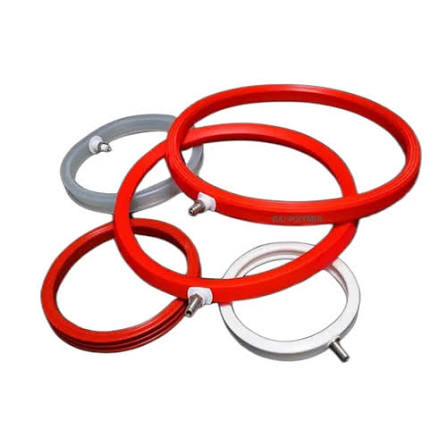
Silicone inflatable seals and gaskets (also known as pneumatic seals) are engineered elastomeric profiles designed to expand and deflate on demand. Utilizing medium (typically air or fluid), these seals expand to bridge variable gaps, dynamic misalignments, and irregular mating surfaces, creating a hermetic, leak-proof barrier. Upon pressure release, the seal retracts cleanly into its mounting channel.
Manufactured from high-purity, food-grade, and medical-grade silicone elastomers, these seals are built to withstand cyclic movement, extreme temperature variations, and aggressive chemical exposure without losing structural memory or elasticity.
Manufacturing Capabilities & Technical Specifications
-
Material Grades: 100% pure silicone rubber, US FDA 21 CFR 177.2600 compliant, USP Class VI medical-grade, flame-retardant (UL 94-V0), and high-temperature resistant formulations.
-
Operating Temperature: $-60^\circ\text{C}$ to $+230^\circ\text{C}$ (specialty compounds up to $+300^\circ\text{C}$).
-
Inflation Pressure Range: Typically $0.5 \text{ bar}$ to $4.0 \text{ bar}$ (custom high-pressure variants available based on cross-section geometry).
-
Bonding & Joining: Seamless endlessly vulcanized joints (hot-cured corners and circular rings) providing equal strength and flexibility across the entire perimeter.
-
Integrated Air Nozzles: Leak-proof vulcanized metal fittings (Stainless Steel 316L, SS304, or Brass) available in threaded, push-in, quick-connect barb, or Schrader valve designs.
Primary Types of Inflatable Seals
Key Industry Applications